

Fes, is a city in Morocco that left an indelible memory with me. I was lost in the narrow streets, fascinated by the stalls full of scents, colors, and life enlivened by stray cats and unexpected people. My lodging, a Riad near the Blue Arch, welcomed me and facilitated my transfer from the airport, making it easier to start exploring Fes.
I immediately immersed myself in the bustling market, with fruits, vegetables and animals. Before taking photos, I wanted to figure out how to avoid disturbing the townspeople or being bothered. The next day, I explored those places again, looking for the tranquility that the previous day’s hustle and bustle did not allow me to fully grasp.


The tannery, an iconic place in Fes that I had already visited in 2015, fascinated me again. There, animal hides are processed in large circular tanks with natural dyes. The pungent smell hit me deeply, even requiring a mint twig to mitigate it.


During my exploration, I met Oussama, a young man who guided me through hidden alleys, revealing the city’s secrets. At the tannery, he accepted a free offer for his guide. We became friends and I also met his brother, the fresh-squeezed orange juice vendor. Sitting at his booth, I captured with my camera the authentic expression of the faces around me.


The next day, I planned to visit Chefchaouen, the famous blue city. After a delicious breakfast of crepes with honey, I planned my trip.
Chefchaouen
My experience in Fes had come to a turning point, and the next day it was time to say goodbye to Mohammed, the kind owner of the Riad who welcomed me. My review in Italian, written in a few words, helped bring as many as seven reservations to the Riad in a single evening. Leaving Fes was a moment of mild regret, but there was another destination waiting for me: Chefchaouen.
The bus ride to Chefchaouen took about four hours. Fortunately, the vehicle was air-conditioned, which was essential given how hot it was already in the spring. Arriving at the bus station in Chefchaouen, we moved to the upper part of town, where the center and our lodging were located.
I woke up early the next morning, eager to capture the features of Chefchaouen. The city is known for its unique charm, but I noticed that over the years it had become very touristy, with many people focused only on snapshots to share on social media, rather than really interacting with the place and its inhabitants. This was not my approach. I wanted to capture people’s daily lives and how they interacted with their environment.
I walked toward the city, without a set route, but with the goal of capturing authentic moments. Chefchaouen was different from the hustle and bustle of Fes: less chaos and more tranquility. I tried to photograph people immersed in their daily activities, observing their expressive faces and gestures that told their story.


One particularly fascinating scene was that of the orange vendors. Trees laden with oranges could be seen everywhere, and vendors prepared freshly squeezed juices for passersby. It was a unique spectacle, full of life and colors.


In the afternoon, we ventured to the upper part of the city, admiring Chefchaouen from a different perspective. The view was breathtaking, and we enjoyed moments of relaxation and tranquility. During sunset, we walked back toward the square, encountering lively scenes. It was as if the city came alive as the sun went down, with sounds, music and games filling the air.
Finally, we shared an authentic dinner in the square, ending a busy day in Chefchaouen on a high note. The next day would be time to return to Fes, but those vivid memories and captured photos would always hold a special place in my thoughts. Chefchaouen, with its magic and authenticity, had left an indelible imprint on my trip.
Fes – Part Two
Here I was on a bus again, this time in the opposite direction, returning to the first city on this trip. I would spend only one night there to break up the journey, before leaving for the desert the next day. The blue gate of Fes, meanwhile, had become my landmark and seemed to be the meeting point for cabs stopping to load and unload passengers. I go to Mohammed’s Riad and share with him some of the experience in Chefchaouen, showing him some photos. He then accompanies me to his friend’s Riad, a short walk away.
Upon arrival, I notice that there is no one in the facility. It seems to me that the owner has no intention of turning his place into a lodging facility for travelers, but it looks more like a private residence, with the owner sleeping on a couch at the entrance, surrounded by cats. He shows me to my room, leaves me the keys, and assures me that he will prepare breakfast for me in his Riad. He is incredibly kind, and his helpfulness impresses me deeply. Perhaps he was also impressed with me and my attitude from the beginning, which sparked in him a desire to help others. I don’t know, but he really behaved like a gentleman.
Returning to Fes on that hot afternoon, I decided to wait for two of my friends while enjoying a mint tea, taking advantage of the freshness that the mint imparted despite being served hot. In advance of my appointment, I stopped at a small place I had noticed in the previous days, but it was so small that I was quick to ask for availability for three people for the evening. Fortunately, there was room for us.
After booking the place, my attention was caught by a donkey parked in a courtyard facing the street. What I saw in those few minutes struck me deeply: it was a picture of poverty. I gave a few euros to the boy who had shown me the courtyard entrance, and I was becoming more and more aware of how poor Morocco was. However, the people seemed to live well, serene, smiling and carefree. Hygiene left something to be desired, but it was a common trait. It was only four o’clock in the afternoon, but I could already feel the intense heat that I had not experienced so far on the road. I decided to take a break for some tea and observe life in the main street, bustling with so many people.


At that moment, I noticed a small repair and gift store with a sign that read “RECYCLING WORKSHOP.” There was a young girl with an engaging smile. I was struck by her beauty, with dark skin and a blue veil that created a fascinating contrast. The waiter who had served me tea seemed to know her, so I asked him if I could take some pictures of her. After a few tries, I finally got a yes. Her name was Sabah, after the region of Borneo, a fascinating coincidence. I think the photo I took of her was one of the most beautiful up to that point.


We explored many out-of-the-ordinary alleys that afternoon, guided by a GPS that was a bit crazy but led us to extraordinary experiences. In one of the narrow streets, we met a group of boys playing soccer. As soon as they saw us, they stopped us and challenged me to kick a penalty kick against the barefoot goalkeeper. It was an exciting moment, and we shared some passes and laughter. Before dinner, I stopped by to say hello to the “pot-bellied” friend I hadn’t seen since I left for Chefchaouen.


I told him about my upcoming trip to the desert. “Inshallah,” he replied, meaning “God willing.” With a tinge of sadness, I ended my stay in Fes, knowing that we would part ways, but with a promise to stay in touch.
Transfer to the Sahara.
I wake up the next morning with great excitement and motivation for the experience that awaited me as the journey continued. I do a quick check in the Riad to make sure I had not forgotten anything. I had prepared everything. I leave Mohammed’s friend’s Riad and head over to him for breakfast. We greet each other with a warm hug and I thank him for everything he did during those days. He returns the thanks and reiterates, “Whatever you need, you have my number.” It is a nice gesture that always makes you feel welcome wherever you go.
The appointment with the owner of Tanboosh Travel was set for 7:20 a.m. in front of his office, and I arrived 5 minutes early. No one was around, just cats and bread. The bakers had left the bread in front of the stores for people who had ordered it the day before, exposed to the air and easily accessible to anyone. An absurd situation.
The owner arrives and signals me to follow him. He escorts me to the square from which we would depart in a 9-seater bus. Again I was lucky: having arrived first, I chose the seat next to the driver. The tour company consisted of seven people in all: a couple of Italians, two Spanish girls, an Austrian guy, me, and the driver. The atmosphere immediately warmed up, with my phone connected to the Bluetooth and all of us singing at the top of our lungs.
After an hour of travel, we stop for coffee and get acquainted. I find myself being the center of attention in a positive sense, the “leader” of the group, a role that comes naturally to me because of my experience as a tour guide. Strong bonds are created in those moments, even if we share only a few hours of experience. We were all there to share a unique travel moment.
The driver was also nice, although he did not speak English very well. After a few kilometers, he suggested that we stop to see the Berber macaques, known as the bertuccas, which inhabit the valleys of the Middle Atlas. It was a unique opportunity to take some nature photos, a special moment.
As we approached the Sahara, the landscape changed color and people took on different attitudes. There were no longer donkeys, but people on the streets, often lying on the ground in groups.


We were almost there, only half an hour away. Something was shaking me, perhaps memories of the trip eight years earlier or the excitement of returning to the same place with different eyes. I ask the guide to call Ibrahim to let him know the point where he would pick me up.


We arrive and the transfer ends. I tip the guide and warmly greet Ibrahim, with whom I had not seen for eight years but remembered well. I also greet the other guys in the bus, exchanging contacts on Instagram. Then I get into Ibrahim’s off-road vehicle and we are headed to his quarters.
In the Sahara
I find myself spending the first two days in a majestic Kasbah, a sort of fortified citadel run by Ibrahim. The facility includes rooms inside and a tented camp under the sand dunes, where I settle in. Right away I feel that I will be there for some time, wanting to fully immerse myself in the experience and take a particular photo: a camel driver on the dunes against the light, a silhouette. I decide not to leave until I realize this shot.


The magic begins at sunset, when the sun begins to set and the camel drivers move through the dunes, some ready for their work, others returned without passengers. The colors at this time are intense and captivating. During a walk, I notice a young local man lying on the dunes, immersed in the present moment. He wears a turban and looks like a local boy. As I observe him and take some photos, he stands up and shyly approaches.

We exchange greetings, and he shows the items he sells to travelers on evening walks. I am struck by a small glass container with embroidery, ideal for carrying some sand (though not allowed).
I ask him if I can take pictures of him in exchange for the purchase, but capturing his facial expression is more important to me. From then on, I will call him “the dune boy,” and this will not be the last time he appears on my journey.


As evening falls and the boy leaves, I take advantage of a walk in the sand, admiring the beauty of the landscape. I return to the Kasbah and share a green tea with mint prepared by Ibrahim. I get to know the young, carefree staff, except for a Brazilian woman at the front desk who seems annoyed by my presence, perhaps because I am Ibrahim’s friend and not an ordinary tourist.
The first evening passes quietly, and during my stay I establish a kind of friendship with the guys who work there.

One of them helps me treat the wounds on my feet caused by sharp stones on the dunes. Meanwhile, a situation with another person, Oussama, proves unpleasant. I become aware of a possible cheat regarding the phone card I had asked to purchase. I decide to act strategically and manage to get what I was entitled to.
I devote the next day to relaxation and light walks in the dunes, considering the pain in my feet and recent injuries. I opt to spend time in the Kasbah lounge, working on content and images captured in Fes and Chefchaouen. I ask Ibrahim if I can arrange a visit to the surrounding villages to discover local life through the eyes of one of his staff members, Houssin.
In the soul of Sahara
I got used to waking up at 6 a.m. to start my photographic day as soon as the light came up, capturing the best moments for pictures. Despite the pain in my feet, I headed for a nearby tented camp where I had seen camels parked. Some camel drivers seemed to be returning to their camp. I thought it might be an opportunity for the photo I longed for: the camel driver against the light, with no tourists on the camels, just him and the animals.
I positioned myself in front of the sun, ready to shoot. Unfortunately, I was unsuccessful, but I still captured the photos. The camel driver stopped near the quarters of some travelers he had just transported. I thought that once he had unloaded the passengers, he would pick up the camels and head home to rest the animals. I decided to approach, noticing another camel driver under the shade of a palm tree. He had parked his two camels ten meters away. If he got back on the road, I would have the opportunity to capture the desired image.
I waited patiently, trying to pretend to photograph the dunes. Finally, the camel driver moved in the right direction, only 5 meters away from me. All I had to do was press the shutter button. Tac. The burst went off. I had captured the image I was looking for. Shortly thereafter, the other cameleer moved, giving me another silhouette.


That morning, at breakfast, I was so happy and satisfied that I had eaten as much as for four people. But that day was yet to hold many surprises for me. It was then that I met Houssin, a young Saharan man full of vitality, and asked him to show me the soul of that part of the world.
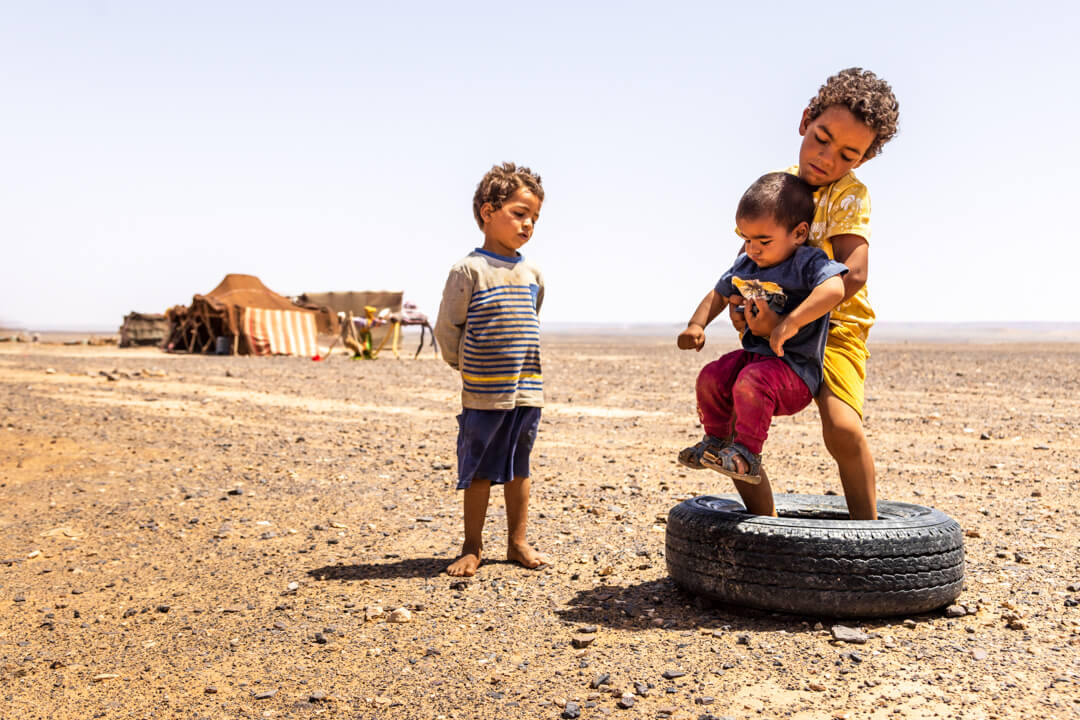
Houssin told me about the changeability of the dunes in the desert, explaining that despite everything, the desert conveyed a constant feeling of vastness. During the jeep ride, I was captivated by a swirl of sand and children playing barefoot in the hot sun. Despite my foot injuries, I could not help but admire them.




That day ended with a night in the desert, led by a young camel driver. We crossed the dunes, stopping at the best spots to take photographs. When we reached the nomadic camp, an elderly Berber man greeted us. The atmosphere was intense and authentic. He fascinated me by telling me about his life in the desert.
Return from nomadic camp, kasbah and camel oasis
The next morning was not what I had imagined: the poncho that had covered me during the night outdoors under the stars proved sufficient even as a blanket. As the camel driver prepared for the crossing, I approached him hoping to spot some animals in the desert, but to no avail.
At that moment, the Saharan came out of the tent, knowing that it was time for departure. He mentioned a greeting and thanked me for choosing his camp. I noticed beautiful light and asked if I could take a portrait. He agreed and struck a pose. That was the most striking photo of the trip, with his scarred face and blue robe against the background of the dunes.

On the way back, I didn’t feel like taking pictures, I just wanted to enjoy those unique moments. The sunset colors, the situation with me and the camel driver in the desert were incredible. Back in the Kasbah of Ibrahim, I binged on honey crepes, green tea and coffee.
Although the sun was high, I went out to take pictures around the Kasbah. Meanwhile, the Brazilian woman at the facility informed me that there would be no room in the evening. Ibrahim reassured her, allowing me to stay as long as I wanted and sleep for free in the lounge.
I remained in the lobby, working on the computer and enjoying tea and coffee. I intercepted the Brazilian woman trying to score consumption, but she did not know that I had a forfeit agreement with Ibrahim. In the afternoon, I took portraits for the boys at the facility, creating a beautiful memory together.


The day passed between PC work and conversations with the boys. The wounds in my feet improved, but the pain persisted. After dinner, I enchanted myself under the starry sky and fell asleep on an outdoor sofa.
I woke up around two o’clock, my feet still sore, and returned to the Kasbah to sleep in my own bed. In the meantime, I exchanged messages with a couple from Turin who were in an exceptional place not far from me. We decided to visit the market together the following day, a place famous for photographs. I was grateful for the good fortune of doing what I loved and knew I had to persevere. A shooting star in the desert darkness seemed to confirm that I was on the right track. And so, after that busy day, I fell asleep, ready to face new adventures.
Il pozzo del cammelliere e il mercato di Rissani
The next morning, Ibrahim informs me that we would not be leaving for Rissani until later, so I decide to devote the time to the music Houssin had recommended. I wrap myself in headphones and start walking along the road outside the Kasbah, a lonely stretch traveled only by guests and camel drivers.
An unexpected encounter surprises me: I see a man drawing water from a well for his dromedaries. I remember photographing him a few days earlier at dawn in the dunes, a camel driver offering nomadic experiences in the desert. It was a special moment, like many chance encounters on the trip.


After 11 a.m., Ibrahim signals for me to leave for Rissani. There, I immerse myself in the chaos of the market, where donkeys dominate as the main means of transportation. Through alleys and crowded streets, I observe unique scenarios: farmers with animals, boys with turkeys, a reality that seemed extracted from a movie.


Later, accompanied by Ibrahim, I enter a bar run by his friend, Moustapha, but his insistence and proposals do not completely convince me. I ask a friend of Moustapha’s who was acting as a guide for help, but he proves to be uncaring. I decide to go on alone and capture with my camera scenes that conveyed freedom and simplicity, particularly men on donkeys.


Despite sore feet, I return to Moustapha’s bar and, watching the bustle of people and animals, realize how fascinating that market is. Later, I remember having to buy a phone charger. Eventually, I note that the price had been inflated for foreigners, a situation that was beginning to tire me.
Back in the Kasbah, I cool off at the pool and devote the afternoon to selecting and editing photos. In the evening, Moustapha visits us and we chat while sipping mint tea and smoking hookah.
He asked me what my plans were after Merzouga, anticipating an offer of lodging in his restaurant with rented rooms. Although it was an opportunity, I still preferred to enjoy the desert and its surprises. With fatigue and sleepiness setting in, I took my leave and went to sleep, ready to face new adventures in the desert the next day.
Last day in the Sahara
I wake up at dawn with no pain in my feet, enjoying that relief. After breakfast, I decide to relax in my room listening to music before heading out in the late afternoon to run some errands in downtown Merzouga.
I am accompanied by an Argentine guest with a car. In the center, I notice the abundance of stores offering quad bike rentals for the dunes, a touristy aspect I dislike. Then, I begin a lonely walk of about 6 km to the Kasbah, encountering enchanting scenery.
At the breeders’ oasis, I find a scene of camel riders resting in the shade, a vision that represents simplicity and life in the desert. Along the way, I reflect on new photographic adventures I may undertake in the future.
In crossing the desert, I take pictures of my shadow on the dunes and meet the dune boy who is watching the desert with a contemplative air. We exchange a few words and I take some photos, knowing that I would be leaving the next day, heading for Rissani.


The next morning, I check out and, surprising the Brazilian woman, pay for only five nights, including meals and drinks, thanks to the agreement with Ibrahim. I leave a tip for the guys at the facility as a token of gratitude.
I bid farewell to the Sahara oasis, promising to return, and greet Ibrahim with a warm hug. It has been an intense and unforgettable week, full of emotions and unique moments that only that place can give. Before leaving, I leave a small gesture of appreciation for the service provided by the boys, aware of the importance of showing gratitude for the hospitality received.

Rissani
My experience with Moustaphà, an individual who introduced me to a part of Moroccan life that I would rather forget. Moustaphà never liked me. He was the kind of profiteering person who would do anything to get money out of me, but after nearly 15 years of solo travel, I have learned to recognize immediately who shows up in front of me. When it comes to being smart, I don’t back down.
I arrive at his place late in the morning and he lets me have coffee in his café, without offering it, having already marked down the price. He makes me wait because the rooms were not yet ready. Rissani is not exactly a lively place on normal days, but I had decided to go to him, even though I was already regretting that choice. But it is part of the trip.
I was upstairs in the café, ordering lunch and working on my computer, trying to manage the work that was piling up day after day.


I could see Moustaphà trying to attract people to his bar, but no one seemed interested in his offerings. When my room was finally ready, I ask for a fan because of the oppressive heat in North Africa.
After getting everything set up, I grab my camera ready to leave, but Moustaphà keeps trying to get me to buy various things, trying to get commissions on what I would buy. Confirmation that he just wanted to take advantage of me comes when he tells me that he would manage my bus trip and I would have to pay everything to him. I decide to make my own arrangements.
I find a bus office and book my ticket to Ouarzazate for two days later. While I wait, I stop at a café for coffee, mint tea, and a bottle of water, watching the prices to be informed when Moustaphà would bill me.
I go back to him in the afternoon and he asks if I want to go to a spa for massage and steam bath. I accept and he immediately tells me that I will have to pay everything to him when I leave. I understand his move and decide to ignore it.
I go back to my room, trying to avoid Moustaphá, but eventually meet him outside my room. We stop to talk and he asks me what I want for dinner. I decide to go elsewhere to say goodbye to the guys I had lunch with.
The next day is market day. As I explore the market, I find interesting shots, trying to capture the authenticity of Rissani. I also photograph a boy carrying a turkey and a man distributing water to the needy using a kind of bagpipe.


I decide to say goodbye to the shopkeeper who had sold me a necklace the day before. We also meet a mute little boy who guides me to the rooftop from which I manage to photograph an owl. At the end, I give him a small tip for his valuable help.


The next day, while I was on the bus, Moustaphà tried to call me but I texted back, avoiding talking to him. This was the last time I saw him.
My trip to Rissani was an interesting experience, despite the annoyance caused by Moustaphà. It taught me to be more vigilant and not to be easily taken advantage of. I can now say that I learned a valuable lesson on how to navigate through the pitfalls of travel, trying to enjoy every experience despite the small obstacles along the way.
Conclusions
After Rissani I had spent a few days between Ouarzazate and Ait Ben Haddou (the place where the scenes were filmed in the movie “The Gladiator” when he fights in the arena along with the slaves).
The last few days I had not devoted to photography. I was tired and it had been almost twenty days that I had been on the road and I had taken almost 3,000 photographs and I felt that I was satisfied with the work and I felt that everything I could have done I did and I did it to the best of my ability.
One shot from this trip a few months down the road will take second place in an international photography competition and it is the shot of the camel driver in backlighting photographed on the dunes in the days I was at Ibrahim’s.

I would like to say thank you to the whole world for this adventure, to my friends who support me, to my parents who since childhood have always given me all the freedom in the world, and to everyone who has contributed in some way to making this adventure happen.